
Your customers are not googling anymore. Not the way they used to, at least. Instead of typing three words into a search bar and scrolling through ten blue links, more of them are asking ChatGPT, Gemini, or Perplexity for a direct recommendation. Or they are reading the AI Overview that now sits at the top of Google and never scrolling past it. This article is your guide to showing up in those answers.
Key Takeaways
The way people search for businesses is fundamentally changing. In 2026, buyers are asking AI platforms for recommendations, reading AI-generated answers, and making decisions before they ever click a traditional link. As of February 2026, 48% of tracked queries trigger AI Overviews on Google, and the zero-click rate in AI Mode reaches 93% for Google searches. If your brand is not appearing in these AI answers, you are quietly disappearing from buying conversations in your market.
Here is the reassuring part: LLM SEO is not a separate discipline that throws out everything you have built. It uses the same fundamentals as traditional SEO, aimed at a new finish line. There is no page two in an AI-generated answer. There is a short list, and you are either on it or you are invisible.
This guide covers the four levers that determine whether AI search engines cite your business:
-
Clear, answer-first content that gives AI tools something specific to extract
-
Schema markup that tells AI exactly what your business is, does, and where it operates
-
A solid technical foundation so AI crawlers can actually reach and index your pages
-
Off-site credibility through reviews, mentions, and consistent business data across the web
By following the steps in this guide, you can audit your AI visibility and make three to five concrete improvements within a week.
What Is LLM SEO (and Why Your Customers’ Questions Moved)
In 2023, a patient looking for dental care typed “best dentist St. George Utah” into Google search and scanned a list of results. In 2026, that same patient asks ChatGPT: “Which dentist in St. George is best for anxious patients?” and gets a single, synthesized answer with two or three names. No scrolling. No comparing ten tabs.
LLM stands for large language models, the technology behind ChatGPT, Gemini, Claude, Perplexity, and Google’s AI Overviews. These models have evolved rapidly through 2024 and 2025, and they are now generating text that directly answers buyer questions. LLM SEO is the practice of making your business easy for these tools to find, understand, trust, and cite when someone asks a relevant question.
AI search now spans multiple ai platforms: Google AI Overviews and AI Mode, Gemini as a standalone ai search interface, Perplexity as a dedicated ai search engine, and answer features inside Copilot and ChatGPT’s “Browse with Bing.” AI models look for entities, clear data structures, and multi-source consensus in digital content, not just keywords.
LLM SEO does not replace traditional SEO. It repurposes the same fundamentals, including crawlability, content quality, and authority, for a world where a single AI summary replaces the search results page you used to compete on.

Why AI Visibility Matters More in 2026 Than Traditional Rankings Alone
AI visibility refers to how often and how prominently your brand appears in ai generated answers across Google AI Overviews, Gemini, ChatGPT, and Perplexity. AI visibility measures brand presence in AI-generated search results, and in 2026 it matters as much as your position in Google search results.
The numbers tell the story. As of February 2026, 48% of queries trigger AI Overviews, and that figure climbs to nearly 65% for question-structured queries. Brands cited in AI Overviews see a 35% increase in click-through rates compared to those that are not mentioned. AI Overviews provide AI-generated snapshots of key information, and more users are reading those snapshots and moving on. AI search platforms now account for 4.2% of global web traffic, a figure that is growing fast.
The zero-click dynamic is real. In AI Mode, the user reads one synthesized snapshot and never scrolls to organic links or local packs. The zero-click rate in AI Mode can reach 93% during searches. Meanwhile, 85% of top news websites block at least one major AI bot, which creates content scarcity and gives brands that allow AI crawling an outsized share of citations.
Compare the old model with the new one: classic SEO visibility means “I am number three in Google search results for Utah injury lawyer.” AI visibility means “ChatGPT, Gemini, and Perplexity all name my firm when asked for the best injury lawyer in Utah.” The second scenario is where the downstream conversions are heading.
How AI Search Engines Actually Build Their Answers
AI search engines blend traditional crawling, LLM reasoning, and citation selection into one synthesized answer. Google AI Overviews and AI Mode use Google’s own index plus Gemini’s reasoning. ChatGPT’s “Browse with Bing” pulls live web content at query time. Perplexity AI fetches, re-ranks, and cites sources in real time. Each platform has slightly different citation behavior, but they share underlying goals: relevance, authority, and freshness.
The critical distinction is the citation model versus the ranking model. In traditional search, you compete for ten positions on a search results page. In AI search, the model picks a small set of sources to support its answer. AI responses depend on external authority sources to validate information. Being cited at all matters more than your numeric rank. AI tools prefer clear question-and-answer formats for better content extraction, and content with cited sources increases AI citation likelihood.
AI engines also favor entity understanding. These models track brands, people, products, and locations as entities, not just words. When deciding which brand to mention, AI engines prefer content that answers questions directly and carries strong entity signals: a clear business name, a specific service area, and consistent data across the web.
The Four Levers of LLM SEO: How to Rank in ChatGPT, Gemini, and AI Overviews
Think of tuning your site for AI search like preparing a car for a race. Content is the fuel. Schema is the dashboard wiring. Technical SEO is your horsepower. Off-site credibility is your reputation on the track.
When we optimize a client for AI visibility at The Active Media, we work on all four levers in parallel rather than chasing hacks on a single AI platform. Here is what each lever covers, with concrete examples for local and national businesses. And these same levers help both traditional Google search rankings and ai generated answers, reinforcing the same-fundamentals-new-finish-line reality.

Clear, Answer-First Content: Fuel for AI-Generated Answers
AI tools quote pages that give direct, unambiguous answers in the first 40 to 60 words. When someone asks “who is the best emergency plumber in St. George open 24/7,” the model is scanning for a page that states exactly that in its opening sentences, not one that buries the answer under three paragraphs of filler.
Relevant and clear data presentation increases the chances of being cited by AI. Restructure your service pages with this approach:
-
First two sentences: State what you do, who you serve, and where you operate
-
Next: Support with details, pricing ranges, and process steps in skimmable bullets
-
Headings: Use question-based headings that mirror real prompts, for example, “Who is the best solar installer in Southern Utah in 2026?”
AI fluff, those pages generated by low-effort AI content creation tools without expertise or data, rarely gets cited. You cannot just create content and expect it to perform. LLMs prefer fact-dense, specific content. Companies should build topic clusters to provide comprehensive coverage of subjects, and regularly updated content signals trustworthiness to AI engines. AI systems favor up-to-date data and unique insights to build trustworthiness.
Schema Markup: Wiring Your Site So AI (and Google Search) Understand It
Schema is structured code behind your site that tells search engines and AI exactly what they are looking at. Think of it as dashboard wiring: it labels your content so machines know “this is a Service,” “this is a LocalBusiness,” “this is a Review.”
Core schema types for 2026:
-
Organization or LocalBusiness – your entity identity
-
Service – what you deliver
-
FAQPage – mirrors real customer questions
-
Product – where relevant
-
Review or AggregateRating – social proof in machine-readable form
Structured data enhances the clarity and retrieval of business information for AI. Utilizing structured data helps AI understand the context of a website’s content. A St. George dentist with LocalBusiness, Service, and FAQPage schema is more likely to be pulled into AI Overviews for “best dentist in St. George for kids” than a similar practice with none.
However, research from Ahrefs tracking nearly 1,900 pages showed that schema alone does not guarantee AI citations. It is a hygiene factor, not a silver bullet. Many sites have broken or invisible schema. Part of The AEO Checklist we run on every new client includes running structured data tests, fixing errors, and expanding coverage across high-value pages. Maintaining consistent information across platforms reduces ambiguity for AI systems.
Technical Foundation: Making Sure AI Can Actually Crawl and Index You
If your site is slow, blocked, or full of soft 404s and unindexed pages, AI tools cannot use your content. A beautiful website that loads like a minivan with three flat tires is a liability with nice photos.
Core technical must-haves for 2026:
-
Fast page load, especially on mobile. Mobile-friendly websites improve user experience and visibility
-
Clean code without plugin bloat
-
Server-side rendering for key content like FAQs and structured data
-
Valid XML sitemaps and no accidental blocking of important URLs in robots.txt
-
Websites must be easily accessible for AI crawlers to ensure discoverability
AI search still depends on Google’s index and other search engine indexes. If a page does not show up in normal search results, it likely will not appear in ai overviews or ai mode either.
A simple self-check you can run today: use Google Search Console for index coverage and Core Web Vitals, test mobile responsiveness on your phone, and run a quick crawl with a freemium tool. High-performance custom web design and development and performance-driven digital marketing services are part of how we prepare brands for both traditional and AI search engines.
Off-Site Credibility: Reviews, Mentions, and the Web’s Opinion of You
AI tools do not just read your website. They read what the rest of the internet says about you. High authority consensus from third-party platforms is important for AI visibility, and your reviews, directory listings, and industry mentions are now direct inputs into whether a model recommends you.
Consistent NAP data (name, address, phone) across Google Business Profile, Apple Maps, Yelp, and industry directories helps AI engines confidently match mentions to the correct business entity. Unified knowledge bases ensure consistent information across all platforms.
Practical steps for businesses, including those looking for top SEO services in St. George, Utah:
-
Fully update your Google Business Profile: categories, hours, services, photos. A complete Google Business Profile enhances local AI visibility
-
Request reviews after every positive interaction; respond within 24 to 72 hours
-
Earn mentions on reputable sites in your industry. AI engines frequently surface businesses with strong, recent, detailed reviews when users ask for “best” or “top-rated” providers
How to Measure AI Visibility (Without Buying Every New Tool)
Traditional SEO tracking tells you positions one through ten in Google search results. AI visibility measurement asks a different question: does your brand appear when someone asks AI?
Here is a simple manual framework you can start this week:
-
List 20 to 30 high-intent questions real customers ask about your services and locations
-
Test each question in Google search (with AI Overviews), Gemini, ChatGPT with browsing, and Perplexity
-
Log whether your brand appears and note who does appear
Track four metrics in a spreadsheet:
|
Metric |
What It Tells You |
|---|---|
|
Citation frequency |
How often your brand is mentioned across AI answers |
|
Share of voice |
How you compare to two or three key competitors (competitive benchmarking) |
|
Sentiment analysis |
How you are described – “one of several” vs. “the best” |
|
Query coverage |
Which service and location combinations you appear for |
|
Prompt-driven audits can identify visibility gaps in how AI tools perceive a business. Monitoring AI-generated responses can improve overall digital visibility strategies. AI visibility measures how often your brand is cited in AI responses, and you can discover patterns by checking monthly and comparing results. |
|
Many SMBs can start with manual checks plus Google Search Console and Google Analytics to evaluate changes in branded search and engagement. As your program matures, specialized tools and expert SEO support help scale beyond manual testing.
What You Can Do This Week to Start Showing Up in AI Search
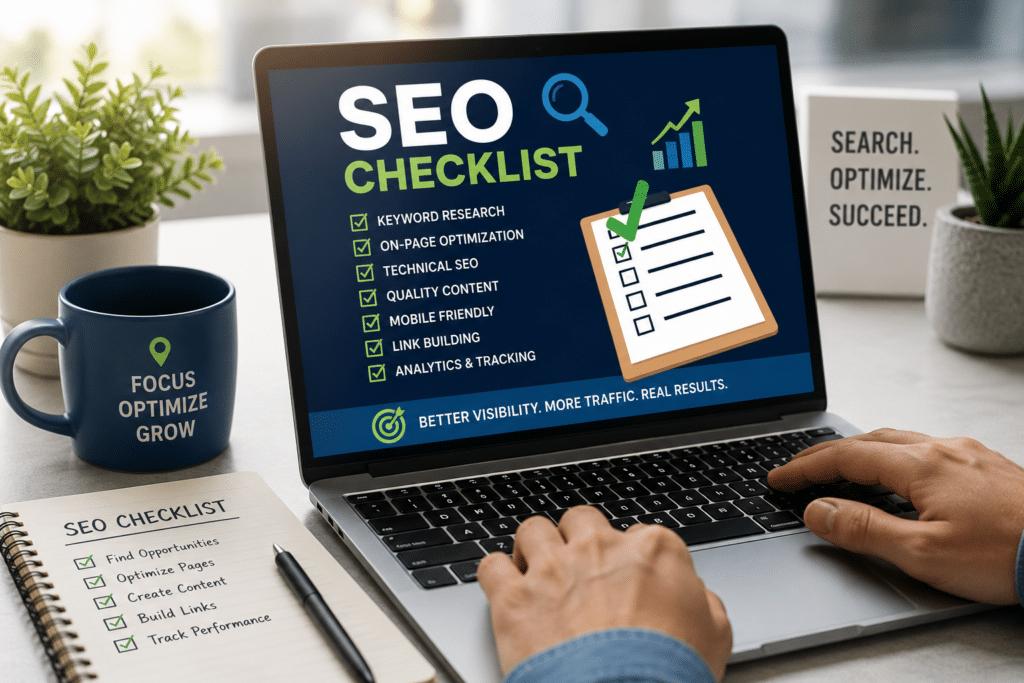
You do not need to overhaul everything at once. Here is a checklist you can complete in three to seven days:
-
Audit your AI presence. Run your top ten customer questions through Google search, AI Overviews, ChatGPT, and Perplexity. Note where your brand appears and who your competitors are
-
Rewrite one key service page. Lead with a clear, answer-first opening that states what you do, who you serve, and where
-
Add or fix schema. Implement LocalBusiness and Service schema on that page. If you are not sure whether you have valid schema, that is your answer
-
Update Google Business Profile. Add services, service areas, fresh photos, and current hours
-
Request reviews. Send a review request to ten to twenty recent customers this week
-
Test on mobile. Load your site on a phone and fix anything obviously broken or slow
-
Document your baseline. Screenshot AI results for your key queries today so you can measure improvements after 30 days
These steps are manageable. Doing them across an entire site and content library is where a specialized digital marketing and SEO agency adds speed and strategy.
How The Active Media Approaches LLM SEO for Utah and National Brands
The Active Media is a St. George, Utah-based digital marketing agency focused on SEO, AI search optimization, PPC, and high-performance web design for growth-minded SMBs. We help businesses appear in ai search, not just rank in traditional search.
A typical 90-day LLM SEO engagement looks like this:
-
Weeks 1–2: AI visibility diagnostic across Google AI Overviews, Gemini, ChatGPT, and Perplexity, including a local SEO audit where applicable
-
Weeks 3–6: Fixes to content, schema, and technical foundations. Every page we touch is built to perform in both traditional search and AI search engines
-
Weeks 7–12: Expansion, measurement, and fine tuning based on real citation data
Generative Engine Optimization and Answer Engine Optimization improve visibility in AI search engines, and our process folds these into existing SEO and PPC programs so clients are not running three separate strategies — a key shift we explore in depth when explaining how Google’s AI Mode changes SEO.
The results speak for themselves. Led by founder Amber and a team focused on client outcomes, The Active Media’s approach helped a local home services brand in Southern Utah gain first-time mentions in AI Overviews within 45 days. A B2B SaaS client saw a five-times increase in pages cited by AI Overviews and a two-times increase in ChatGPT mentions after a content and schema overhaul.
Ready to find out where you stand? Get in touch with The Active Media or contact our digital marketing and SEO experts for a full AI search visibility diagnostic and a tailored roadmap for your business.
The Honest Truth About AI Search (And What Won’t Work)
We will not pretend anyone has this perfectly solved. These systems change month to month. AI search optimization requires a focus on authoritative and machine-readable data, but nobody can guarantee a fixed number of AI citations by a certain date. Anyone promising you position one in ChatGPT is selling something we would not buy.
Common mistakes to avoid:
-
Chasing “secret prompts” that supposedly hack AI recommendations
-
Mass-producing low-quality AI content without expertise, data, or clarity
-
Blocking all AI crawlers out of fear, which quietly removes you from AI search results. Remember, 85% of top news websites block major AI bots, and that creates an opportunity for brands willing to be visible
The businesses consistently showing up have three things in common: clear, specific content; a clean technical setup; and real-world trust signals like reviews and authoritative citations. The model’s predictions about which sources to cite favor brands with this foundation.
View LLM SEO as asset-building. You are not chasing an algorithm. You are building a brand’s presence that holds its value as the models evolve. Focus on the fundamentals in this guide, and you will be in a stronger position no matter what Google, OpenAI, or Anthropic launches next quarter.
Let’s get your competition in your rearview mirror.
FAQ: Common Questions About Showing Up When Customers Ask AI
Is LLM SEO different from traditional SEO, or do I need two separate strategies?
You do not need two separate strategies. LLM SEO is an evolution of traditional SEO that emphasizes answer-first content, structured data, and entity clarity so AI search engines can confidently cite your brand. Most work you do for classic Google rankings, including technical fixes, content depth, and backlinks, also improves your chances of appearing in AI Overviews and AI-generated answers. The main difference is how success is measured: instead of tracking only positions in Google search results, you also track whether Gemini, ChatGPT, and Perplexity mention you for your critical queries.
Should I block AI crawlers like GPTBot or Google-Extended to protect my content?
Unless you are a publisher with paywalled or highly sensitive content, most SMBs and B2B brands benefit from allowing reputable AI crawlers to access their public pages. Blocking all AI bots means your content cannot be used in AI-generated answers, which dramatically reduces your AI visibility and lets competitors dominate recommendations. A balanced approach works: allow major AI crawlers to index high-intent, marketing-friendly content while using robots.txt directives for any sections you truly need to protect.
How long does it usually take to see results from LLM SEO work?
Some early shifts in AI citations and AI Overview appearances can happen within 30 to 60 days of solid content, schema, and technical improvements. More meaningful share-of-voice gains across multiple AI search engines often take 60 to 90 days, depending on competition, domain authority, and content quality. Monitor both AI mentions and leading indicators like branded search volume, market share changes, and review growth over a three-to-six-month window as Google’s AI Mode continues to reshape SEO.
Can I measure AI visibility without expensive enterprise tools?
Yes. Start manually by testing a curated list of real customer questions in Google AI Overviews, Gemini, ChatGPT with browsing, and Perplexity every month. Log whether your brand appears. Combine those manual checks with Google Search Console for branded queries and click data, Google Analytics for engagement, and basic rank trackers for traditional SEO context. As your program matures, specialized tools and agency support, like The Active Media’s AI visibility diagnostics, help scale beyond manual testing.
Do I need to rewrite my entire website for AI search, or can I start small?
You do not need to rebuild everything at once. Start with your top three to five revenue-driving or lead-generating pages. Prioritize pages that map to high-intent questions customers already ask, such as pricing, location-specific services, or comparison pages, and optimize those for answer-first clarity and schema. Once those pages start performing better in both traditional and AI search, roll the same process across the rest of the site using a structured roadmap. AI search optimization is a language of continuous improvement, not a one-time overhaul.