Here is a scenario we see almost every week. A business owner comes to us convinced their ads are a waste of money. The platform reports dozens of clicks. The phone, they say, has not rung once. So the conclusion writes itself: the marketing does not work.
Sometimes that is true. But a huge amount of the time, the marketing is working fine. The leads are arriving. The owner simply cannot see them, because conversion tracking—the process of measuring and confirming when a lead takes a real action like a form submission, call, or booking—is broken and nobody told them. They are flying blind, and they are about to cut the exact thing that is feeding their business.
For business owners and marketers, especially small-to-mid sized companies and entrepreneurs putting real money into digital campaigns, that gap is expensive. When budgets tighten, bad tracking hides ROI, pollutes reporting, and makes good campaigns look disposable. No race team runs a car without telemetry. Every brake point, every tire temperature, every fuel reading streams back to the pit wall, because “the car felt fast” is not data. If you cannot measure the lap, you cannot improve the lap.
Most businesses run their marketing on exactly that: a feeling and a monthly invoice. Conversion tracking is your telemetry. Below, we break down five common places it goes dark—broken tags, silent automation failures, untracked phone calls, and internal data pollution—and how to fix them, whether you are running your own ads or leaning on conversion-driven PPC campaign management to make every dollar accountable.
The click was never the finish line
When an ad platform reports a click, all it knows is that someone tapped your ad and a page loaded. Tracking conversions means measuring whether those clicks led to valuable actions on your website, not treating clicks as the goal. That is it. The platform hands the visitor off at your front door and then it is blind too. It has no idea whether that person called, submitted a form, booked, or bounced in two seconds.
If you only look at clicks, you are grading the race at the first corner and calling it a win. Businesses need business goals and conversions defined as measurable actions, such as a purchase, a form fill, or app downloads. Those actions become conversion events that guide advertising, help optimize performance, and usually improve ROI more than chasing clicks. Clicks are the start line. Leads are the finish line. And the finish line is something you have to wire up yourself. The platform will never do it for you.
The conversion tag in your Google Ads account never fired
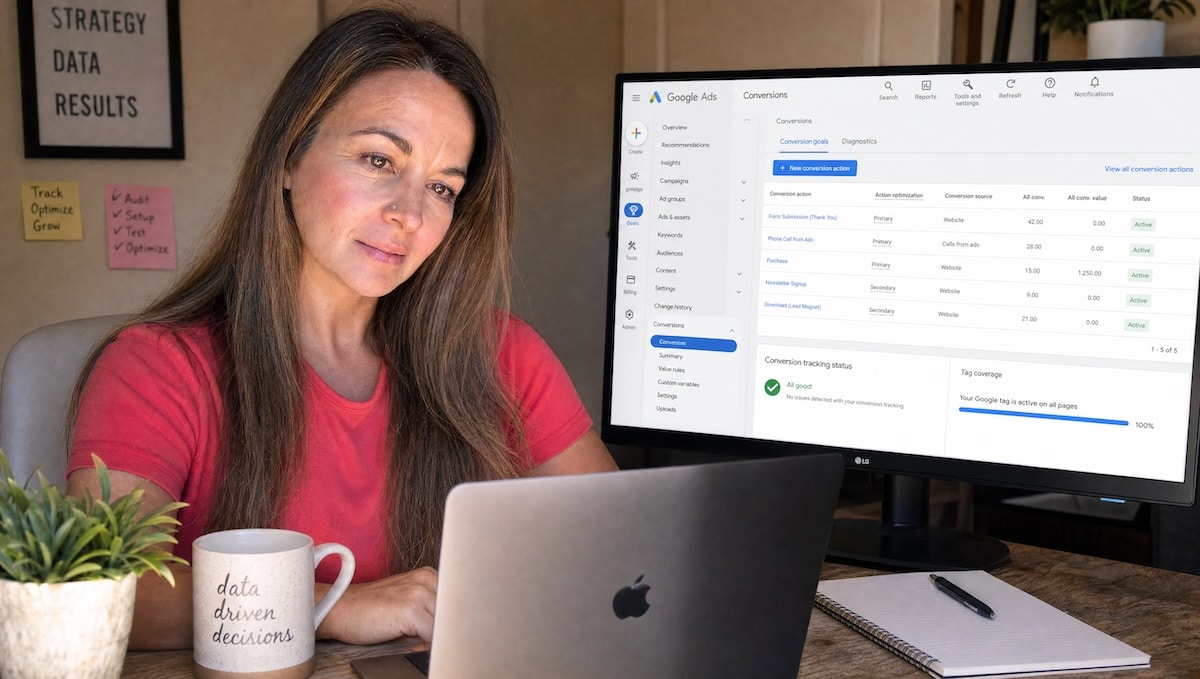
When someone completes the action you actually care about, submitting a form, booking a call, reaching a thank-you page, a conversion action tied to a tag on the website is supposed to fire and record that as real conversion events. In a lot of setups, that tag lives at the very end of the journey, often inside a CRM the owner does not fully control. In google ads, google analytics, or a google ads account, marketers often use google tag manager as the tool to create events GA4 does not capture automatically, mark key events, and import conversions. If it was never installed, or access was never granted, a real lead can travel all the way through and the system will simply never raise its hand.
A basic set up conversion tracking process can be marketer-managed in about 15 minutes when access is in place, and it may also include the linkedin insight tag, a lightweight insight tag that captures website conversions from website interactions. The activity is invisible, not absent. That is a completely different problem from “the ads do not work,” and it has a completely different fix: confirm a conversion tag fires at the true end of the journey, wherever the lead genuinely lands, and get access to whatever system that is.
The automation failed silently
Many businesses pass leads from a form into a CRM through an automation. The dangerous assumption is that silence means success. It does not. No error message is not the same as no error. An automation can quietly stop passing leads and never once warn you. It just goes dark while you keep assuming the pipe is flowing. Privacy limits in the browser and ad-blockers can block client-side tags and cause conversion tracking to underreport by 15% to 30%.
Months can pass this way, with real prospects who wanted to hire you evaporating into a gap in the plumbing. This is the most expensive silence in marketing, and almost nobody checks for it. The fix is two parts: turn on failure alerts for every integration in the chain, use server-side tracking to collect and send conversion data more reliably, recover lost signals, and improve reporting accuracy, and then send a test lead through yourself and watch it travel all the way to the end. Do not trust the pipe. Test the pipe. Modern setups often rely on multi-touch attribution, and some businesses also use other platforms to import conversions from external sources, including online and offline outcomes, or manually upload conversion data to LinkedIn Campaign Manager to reduce gaps.
The phone calls nobody is counting
For many local and service businesses, the best leads do not fill out a form. They call. And if that call forwards straight to a personal cell phone, there is no way to know whether it came from an ad, a blog post, or a neighbor. The single highest-intent action a prospect can take, picking up the phone, becomes the one action you are not measuring. The customer journey can include several interactions before a prospect is converting, not just one call from a single customer.
Call tracking solves this. A tracking number sits on the ad and forwards to the real phone, so nothing changes for the owner, but every call now carries data: what the caller searched, which source it came from, how long they talked. To measure conversions accurately, attribution windows define how long after a click a conversion counts, so they should match the sales process, and multi-touch attribution helps credit calls influenced by earlier ads or channels. It often costs only a few dollars a month per number. That is not an expense. That is telemetry on your most valuable leads.
You are polluting your own conversion data
Sometimes the data lies in the other direction. We regularly open an analytics account and find the numbers skewed by the owner’s own team, who have been in and out of the site building, testing, and editing. Those internal visits are not customers, but they are counted as traffic, and they quietly distort every decision made from that dashboard, just like common in‑house errors outlined in SEO mistakes most internal marketing teams make. The right analytics platform or tracking tool depends on business goals and technical needs, so cleanup should happen inside the same measurement setup you actually use.
The fix is simple: exclude your team’s IP addresses so your own visits stop registering. Clean data first. Decisions second. Consent-aware measurement can reduce gaps caused by user opt-out decisions, and conversion accuracy also varies by business model and server-side setup. A dashboard that is half you is not a dashboard, it is a mirror, and pairing that with the right mix of free marketing tools and SEO resources makes more informed decisions easier and improves advertising performance over time. Once the data is clean, review key performance indicators like conversion rate and customer acquisition cost, calculate conversion rate consistently, watch ad spend trends, and use A/B testing to improve results over time.
The fix: enable conversion tracking, and why it matters right now
Notice that none of these fixes is “spend more money.” Define what a conversion actually is by choosing the high-value conversion events that align with business objectives. For example, event specific conversions happen when users click a key button or submit a form online and you count that action as valuable. Wire the conversion tag to fire at the true finish line. Set failure alerts and test the pipe end to end. Track your calls. Filter out your own traffic. That is the whole checklist, and most businesses can work through it in an afternoon.
This matters more as budgets tighten heading into the holidays and the new year. When money gets tight, the first thing cut is the thing nobody can prove is working. If your marketing is quietly succeeding but invisibly, you are at risk of cutting the very thing that feeds you, simply because you had no telemetry to defend it. Tracking is how good work survives a lean quarter.
If you are not sure whether your tracking is intact, start with one test. Send a lead through your own system and follow it all the way to the end. If it shows up where it should, you have telemetry. If it does not, you have just found the most expensive leak in your business, and now you can fix it. That is not magic. It is method. And if you would rather we run that teardown for you, that is exactly the kind of work we do.