
Web design for healthcare practices that turns visitors into patients.
We partner one-to-one with therapists, physicians, functional medicine providers and wellness practitioners to build sites that hold up to HIPAA, meet accessibility standards, and get found by the patients you actually want.
Starting investment
Typical launch
Level AA tested
No account managers
BAA in place
Signed with every vendor that touches patient data.
Screen reader clean
Every form labelled, every flow keyboard operable.
Most agencies treat a medical practice like any other small business. It is not. The cost of getting a healthcare website wrong is measured in regulatory exposure, not just lost leads.
The moment a contact form asks why someone is seeking care, or scheduling captures a reason for visit, your website is touching PHI. That changes which vendors you can use and what agreements you need signed.
45 CFR 164.308(b)
People searching for a healthcare provider are rarely browsing casually. They are worried and comparing. Design either builds trust in those first seconds or quietly loses the patient to the next result.
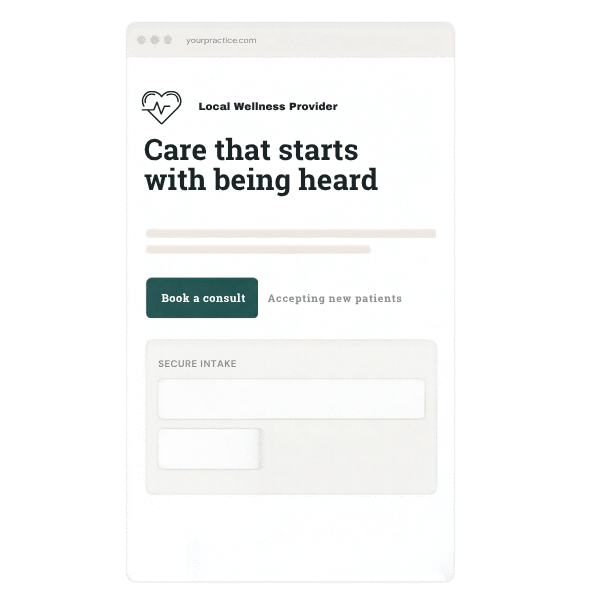
Trust is a layout decision
Healthcare organizations face more accessibility litigation than almost any other sector. A site that fails accessibility standards excludes patients with disabilities and creates real legal risk.
WCAG 2.2 Level AA
Each of these has a different patient journey. A single template cannot serve them all, which is why we do not use one.
Private practice clinicians who need a site that communicates warmth and clinical competence at once, with intake and scheduling that does not create HIPAA headaches.
Family medicine, specialty clinics and concierge practices that need a medical website doing real work: explaining treatment options and converting potential patients.
Practices with a longer education cycle, where content strategy matters as much as design because patients need to understand the model before they book.
Higher-consideration treatments where credibility signals and clear pricing move people from research to consultation.
Chiropractic, nutrition, physical therapy and recovery practices that compete on experience as much as outcomes.
Tell us how patients find you today and we will tell you honestly whether a rebuild is worth it.
It depends entirely on whether your site collects or transmits PHI. A brochure site listing services, credentials and a phone number generally does not trigger HIPAA. The moment you add an intake form, a patient portal or scheduling that captures clinical detail, the calculus changes.
We are a web design agency, not your compliance counsel. We will tell you plainly when it is time to loop in an attorney.
Accessibility is the compliance issue most healthcare websites ignore until a demand letter arrives. The working standard is WCAG 2.2 Level AA.
Patients with disabilities are patients. A site they cannot use sends them to a competitor.
We check your forms for insecure PHI handling, run a WCAG 2.2 AA pass, and send you the findings. No pitch attached.
If patients cannot book appointments in a few taps, they call a competitor who lets them.
Mobile-first layouts and tap targets sized for thumbs, not a desktop page that technically resizes.
Do you treat my condition, do you take my insurance, where are you, how do I book. Everything else is secondary.
Credentials, training and a real photograph. Patients research their clinicians before they commit.
One page per major service, each targeting how patients actually search. This is what lets you rank higher.
A smooth experience from your site into their records, where your practice management system supports it.
New patients want to know exactly what happens after they reach out.
Ongoing valuable content drives traffic over time and gives search engines a reason to return.
A beautiful new website nobody finds is an expensive brochure. We map the relevant keywords your potential patients actually use, which is almost never the clinical terminology you use.
Being cited in an AI Overview now matters as much as ranking beneath it. We structure every page so answer engines can quote it.
Six week build. Larger multi-provider practices quoted separately. The number does not move once quoted.
You talk to the people building your site, not an account manager relaying messages.
These are the questions Google is showing in People Also Ask for this topic, answered directly so both patients and answer engines can quote them.
If it collects or transmits protected health information, yes. A simple informational site with a phone number typically does not. An intake form, patient portal or scheduling tool that captures clinical detail does. We assess this during discovery.
Our Starter Practitioner Package begins at $3,250 for up to 10 pages. Larger multi-provider practices and sites with patient portal integration scale from there. We quote before we start.
Roughly six weeks for a starter site, assuming content arrives on schedule. Complex builds with integrations run longer, and we give you a dated roadmap at kickoff.
Often, yes. We audit the current site for HIPAA exposure, accessibility standards, speed and medical SEO, then tell you honestly whether remediation or a rebuild is the better investment.
Yes. We are based in St. George and work with medical professionals across North America.
Book a strategy call and we will walk through your current site, where patients are dropping off, and what it would take to fix it.
Someone will be in touch within 24 business hours.